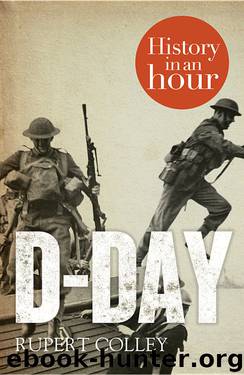
D-Day: History in an Hour by Rupert Colley
Author:Rupert Colley [Colley, Rupert]
Language: eng
Format: epub, azw3
Publisher: HarperCollinsPublishers
Published: 2014-02-12T14:00:00+00:00
THE BATTLE OF NORMANDY
During the following morning, 7 June, British troops captured Bayeux with relative ease; the first French city to be liberated.
British soldier inspecting identity cards of French civilians, Normandy.
In the days following D-Day, both the Allies and the Germans fought for control of Normandy and the Cotentin Peninsula. The Allies’ first objective was to connect the gains they had made on 6 June on and around the five beaches. On 12 June, this was achieved when, after an intense house-to-house battle, the 101st Airborne Division captured the village of Carentan. The Allies now controlled an area, a bridgehead, forty-two miles wide and, at its deepest, fifteen miles deep. From this base, the US troops laid siege to Cherbourg and the British and Canadians to Caen.
As planned, the defunct merchant ships were tugged or, in some instances, sailed across the Channel and then sunk in rows, forming the sheltered conditions for the two Mulberry Harbours. The harbours, which themselves were towed across by 150 tugs, were pieced together and ready for use within two days – the British one at Arromanches, off Gold beach, and the US harbour off Omaha beach. Within the first two weeks, almost 500,000 men had poured in via the harbours or the beaches, together with almost 100,000 vehicles. But on 19 June, severe gales destroyed the American harbour and rendered the British one almost unserviceable for several days. Later, on 12 August, the first PLUTO pipeline, running from the Isle of Wight to Cherbourg, became operational. Over the coming weeks, another seventeen lines were laid. By March 1945, the PLUTO lines were pumping up to a million gallons of fuel each day into France.
Meanwhile, in June, having secured their bridgehead, the Allies now had to break out of the Cotentin Peninsula but in this they were, for the time being, frustrated. The Germans rushed in reinforcements – although Allied bombing and resistance sabotage delayed them – and encircled the Allies within their bridgehead. The battle now became a war of attrition as opposing forces fought field for field, town for town. The terrain of Normandy, dense hedgerows and sunken lanes, known by the locals as bocage, favoured the defence and proved difficult for the Allied tanks. In mid-July, the Americans nullified the German advantage, to an extent, by inventing what they called a ‘hedgebuster’, akin to a large garden fork, which they attached to the front of their tanks, making them capable of quickly cutting through the hedges.
Download
This site does not store any files on its server. We only index and link to content provided by other sites. Please contact the content providers to delete copyright contents if any and email us, we'll remove relevant links or contents immediately.
| Africa | Asia |
| Canadian | Europe |
| Holocaust | Latin America |
| Middle East | United States |
Fanny Burney by Claire Harman(26607)
Empire of the Sikhs by Patwant Singh(23090)
Out of India by Michael Foss(16861)
Leonardo da Vinci by Walter Isaacson(13341)
Small Great Things by Jodi Picoult(7156)
The Six Wives Of Henry VIII (WOMEN IN HISTORY) by Fraser Antonia(5519)
The Wind in My Hair by Masih Alinejad(5103)
A Higher Loyalty: Truth, Lies, and Leadership by James Comey(4967)
The Crown by Robert Lacey(4820)
The Lonely City by Olivia Laing(4808)
Millionaire: The Philanderer, Gambler, and Duelist Who Invented Modern Finance by Janet Gleeson(4482)
The Iron Duke by The Iron Duke(4367)
Papillon (English) by Henri Charrière(4278)
Sticky Fingers by Joe Hagan(4207)
Joan of Arc by Mary Gordon(4117)
Alive: The Story of the Andes Survivors by Piers Paul Read(4037)
Stalin by Stephen Kotkin(3973)
Aleister Crowley: The Biography by Tobias Churton(3646)
Ants Among Elephants by Sujatha Gidla(3470)
